

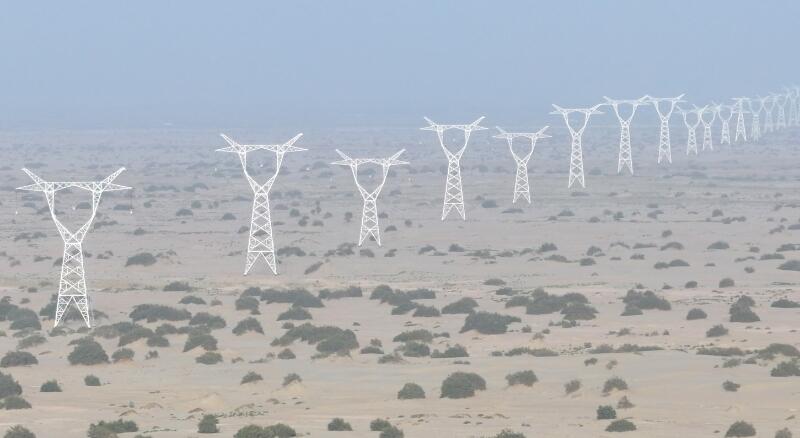
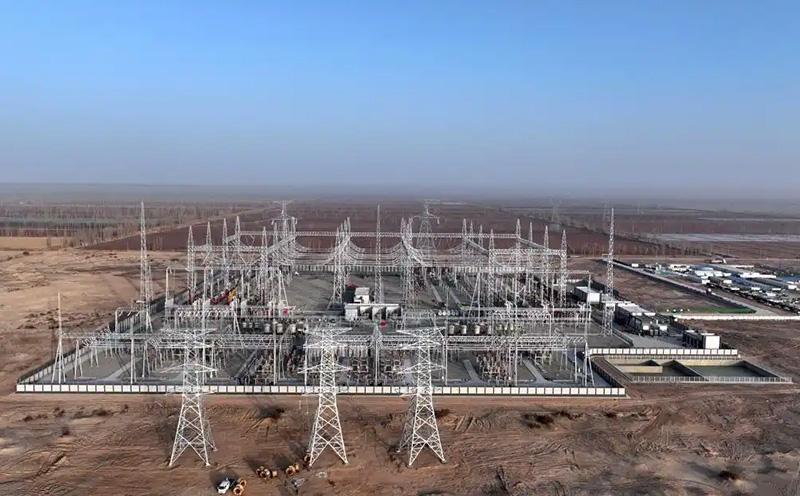
On December 25, 2025, the 750-kilovolt transmission and substation project from Kuqa to Aral to Bachu was officially put into operation, marking the full completion and operation of the Aral ring network. This signifies the establishment of Xinjiang’s complete “Seven Inner Ring Networks” main grid framework.
The Kuche-Alar-Bachu 750 kV transmission and substation project has a total investment of 3.04 billion yuan. It starts from the Kuqa 750 kV substation and ends at the Bachu 750 kV substation, with a newly constructed Alar 750 kV substation and a total line length of 485.029 kilometers.
The Arar loop network is the last ultra-high-voltage loop network project commissioned during the 14th Five-Year Plan period in Xinjiang. The loop network consists of three 750-kilovolt power transmission and transformation projects: the Kuqa-Aksu-Bachu double-circuit line, and the Kuqa-A’la’er-Bachu line, encompassing four substations and a total line length of 1,458 kilometers. Among these, the 750-kilovolt power transmission and transformation projects for the Kuqa-Aksu-Bachu first and second circuits were commissioned in 2015 and 2021, respectively.
Zhang Huiling, Director of the Construction Department of State Grid Xinjiang Electric Power Co., Ltd., stated that after the loop network is completed, the power interconnection capacity between southern and northern Xinjiang will increase by 400,000 to 500,000 kilowatts. This will fully meet the demand for large-scale development and transmission of renewable energy in southern Xinjiang and load growth, effectively alleviating regional power supply pressure and providing solid electricity support for local industrial upgrading and livelihood improvement.
Xinjiang is a single chessboard, with southern Xinjiang serving as the “eye.” In recent years, with the deepening implementation of the “dual carbon” goals, the advantages of southern Xinjiang’s renewable energy resources have become increasingly prominent. State Grid Xinjiang Electric Power Co., Ltd. has continuously intensified efforts to expand the power grid in southern Xinjiang. Since the completion of the first 750-kilovolt line in southern Xinjiang in 2010, 10 such projects have been completed over the past 15 years, forming three ultra-high voltage ring networks in Kashgar, around the Tarim Basin, and in Aral.